What Is a Trading Confluence and How Do You Combine Several Without Overloading a Setup?
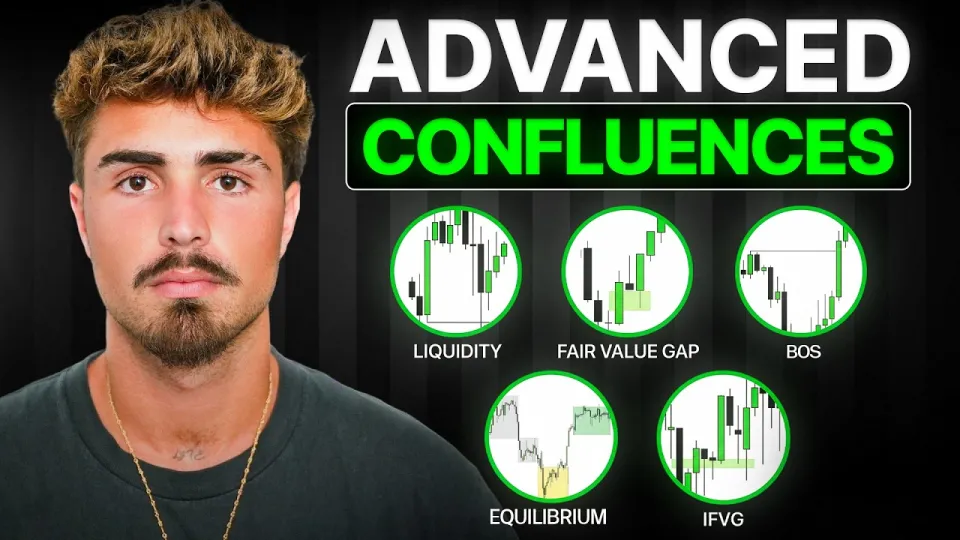
Video: Learn Every Trading Confluence In 18 Minutes
Need articles like this for your video? They help promote it on YouTube and Google — order them in the Telegram bot @sat_sit_bot. The bot writes and publishes the articles itself (with your YouTube video embedded) on popular topical websites (no ads). Try it free: 50 articles on us.
A trading confluence is an additional, independent reason to take a trade that already has a valid entry trigger, and the practical answer is to combine three to five signals that come from different sources rather than piling on every indicator you can find. In the video "Learn Every Trading Confluence In 18 Minutes", the channel TJR walks through the core price-action building blocks traders stack together, and the same framework is the backbone of the free trader blueprint at go.tjrtrades.com/blueprint-nviugv1. The goal is not to collect signals but to raise the probability of a setup while keeping the stop loss in a place where being wrong is cheap.
What does trading confluence actually mean in practice
A confluence is a second reason to enter that is logically separate from the first one, so two versions of the same signal do not count as two confluences. If a fair value gap and a break of structure both point the same way, that is one idea expressed twice, not a stronger setup. A real confluence comes from a different category: a liquidity level, a higher-timeframe zone, a session open, a round number, or an order block that sits behind the entry.
In TJR's breakdown the building blocks are liquidity, fair value gaps, inverse fair value gaps, equal highs and equal lows, and breaks of structure. Each one answers a different question: where resting orders sit, where price moved too fast, where a failed imbalance flipped into support or resistance, where stops cluster, and where the trend direction changed. When two answers agree, the trade has a confluence.
The five building blocks TJR covers
These five concepts cover most of what traders call confluence on a price chart, and each one is worth learning in isolation before combining it with anything else.
- Liquidity. Clusters of stop orders and pending orders above equal highs, below equal lows, or around obvious swing points. Price is often drawn to them, so a setup that targets liquidity has a natural destination.
- Fair value gap. A three-candle imbalance where price moved so fast that one side of the range was not traded. Traders treat the gap as a zone price may return to before continuing.
- Inverse fair value gap. A fair value gap that failed to hold and now acts in the opposite direction, flipping from support to resistance or the reverse.
- Equal highs and equal lows. Two or more swing points at nearly the same price, which usually mark where retail stops are parked and where a sweep is likely.
- Break of structure. A close beyond a prior swing high or low that confirms a shift in direction and gives the trade a directional bias.
None of these is a signal on its own. A fair value gap in the middle of nowhere is just a gap; the same gap sitting behind a swept equal low and aligned with a break of structure is a setup.
How to stack confluences without overloading a setup
The working rule is that a confluence only counts if it changes something measurable, either the probability of the setup or the placement of your stop. If adding a signal does not move your invalidation level and does not change how you would manage the trade, it is decoration.
A practical checklist looks like this:
- Direction first. Establish bias from the higher timeframe with a break of structure, then look for entries only in that direction.
- Location second. Require the entry to sit at a level, not in open space: a fair value gap, an inverse gap, or a liquidity pool.
- Trigger third. Wait for the actual confirmation, such as a sweep of equal highs followed by a displacement candle.
- Risk last. Place the stop beyond the level that invalidates the idea, and size the position from that distance.
Three to five confluences is usually enough. Ten signals on one chart almost always means the trader is fitting the analysis to a position they already want to take, which is the opposite of discipline.
Do more confluences make a trade better
More confluences do not automatically make a trade better, because each additional condition also reduces the number of valid setups and increases the chance of analysis paralysis. A trader who needs eight boxes ticked will sit out most of the session and then force a trade that only half fits.
The more useful question is whether the confluences are independent. A fair value gap that overlaps an order block and a higher-timeframe demand zone is one location described three ways, and it should be treated as a single, well-defined area. Two genuinely independent signals, for example a liquidity sweep plus a break of structure, often matter more than five overlapping ones.
Timeframe also matters. A break of structure on a higher timeframe outranks a fair value gap on a one-minute chart, so weight your confluences instead of counting them equally.
Common questions traders raise about confluence setups
Most doubts around this topic come from execution rather than from theory, and the concerns repeat across trading communities.
- "Which confluences actually add value?" The ones that change your stop placement or your target. If a signal does neither, drop it from the checklist.
- "How long should it take to learn?" Longer than a video. Rewatching an 18-minute breakdown and taking notes is a starting point; screen time and a journal are what convert the notes into a process.
- "Why do I still lose if I follow the rules?" Because a high-probability setup is still probabilistic. Losing streaks are normal, and position sizing decides whether you survive them.
- "Is the market manipulated against retail traders?" Liquidity pools exist because stops cluster in predictable places, and that is a structural feature of how orders sit on a chart rather than a personal attack on any one trader.
- "Should I trust screenshots of huge weekly gains?" No. Treat unverified profit claims as marketing, and judge a method by your own logged results.
Keeping a journal of every setup, the confluences present, and the outcome is the fastest way to find out which signals actually pay for you.
Useful links
- Trader blueprint and full system: https://go.tjrtrades.com/blueprint-nviugv1
- Indicators used in the breakdown: https://go.tjrtrades.com/indicators-6qf6zb4
- Funded account raffle: https://form.tjrtrades.com/funded-contest
- Alpha Futures funded accounts, 10% off: https://app.alpha-futures.com/signup/TJR/
- Lucid Trading, 40% off: https://lucidtrading.com/ref/TJR/
Final thoughts on building a confluence-based process
Confluence trading works when it is treated as a filter rather than a collection: direction from structure, location from imbalances and liquidity, trigger from a sweep or displacement, and risk from the invalidation level. TJR's 18-minute breakdown is a compact map of the vocabulary, but the edge comes from applying one or two combinations consistently and logging the results. Start with a single setup, add a confluence only when it clearly improves your stop or your hit rate, and let the journal tell you when the checklist is finished. If you want the structured version of that process, the blueprint is the place to begin: get the full trading system here.
Key takeaways
- A confluence is a second, independent reason to take a trade that already has a valid entry trigger.
- TJR's 18-minute breakdown covers five building blocks: liquidity, fair value gaps, inverse fair value gaps, equal highs and lows, and breaks of structure.
- Stacking more signals is not automatically better: a confluence only counts if it changes where your stop goes or how likely the setup is to work.
- The same concept works on any timeframe, but a signal from a higher timeframe carries more weight than one from a lower timeframe.
- Most losses come from execution, not from missing signals, so risk per trade and journaling matter more than the number of confluences.
Questions & answers
What is a trading confluence in simple terms?
It is an extra reason to take a trade on top of your entry trigger, coming from a different source such as liquidity, a fair value gap, or a higher-timeframe level. Two signals that describe the same zone count as one confluence, not two.
How many confluences should a single setup have?
Three to five independent conditions is a workable range for most intraday traders. Beyond that, the checklist starts filtering out good trades and encourages forcing setups that only partially fit.
Which confluence matters most for a beginner?
Directional bias from a break of structure on a higher timeframe, combined with an entry at a clearly defined level. That pair alone removes most random entries, and additional signals can be layered in later.
Can confluence trading guarantee profits?
No. A confluence raises the probability of a setup but does not remove losing trades, and day trading remains risky with most participants losing money. Position sizing and a written journal determine whether a method survives a losing streak.
Source: Learn Every Trading Confluence In 18 Minutes · Markdown version